
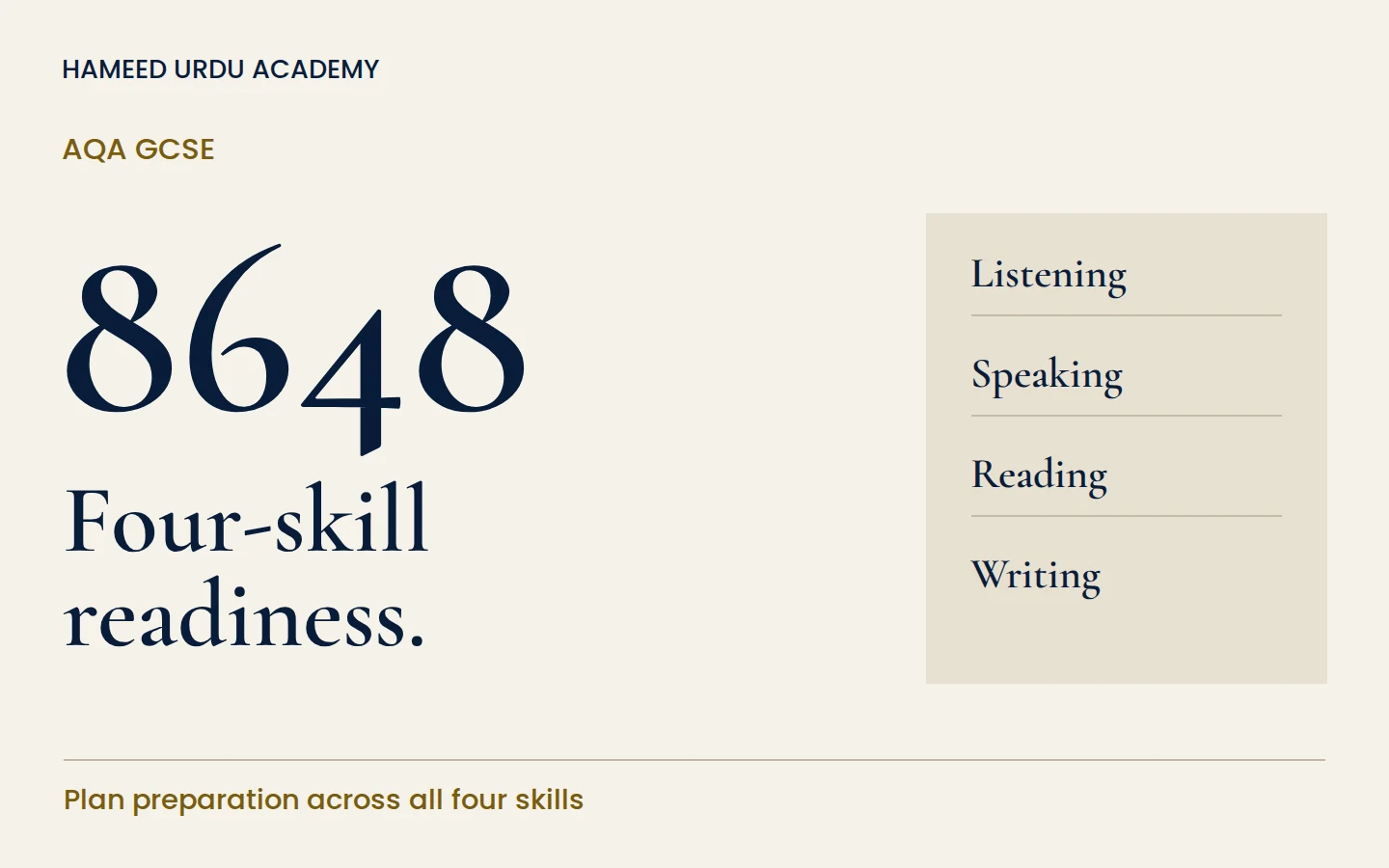
AQA GCSE Urdu readiness must be checked across four separate skills. Listening, speaking, reading and writing each contribute 25% of the qualification. Students enter Foundation or Higher tier, and AQA requires the same tier across all four papers in the same series.
The assessment map
| Paper | Focus | Verified weighting and feature |
|---|---|---|
| 1 | Listening | 25%; Foundation 35 minutes or Higher 45 minutes, plus 5 minutes reading time. |
| 2 | Speaking | 25%; role-play, photo card and general conversation. |
| 3 | Reading | 25%; includes translation from Urdu into English. |
| 4 | Writing | 25%; includes translation from English into Urdu. |
Why one total score is not enough
A fluent home speaker may communicate confidently but still need work on reading inference, formal writing or translation. Another student may write accurately but hesitate in spontaneous speaking. Record separate evidence for every skill so the plan targets the real limitation.
A repeatable practice cycle
- Attempt: complete a short task under a realistic time limit.
- Diagnose: label each issue as understanding, task method, language control or timing.
- Teach: correct one pattern with a clear model and guided examples.
- Reattempt: apply the same decision to a fresh task.
- Record: update the skill score only when new evidence improves.
Speaking and translation checks
For speaking, practise giving a direct answer, a reason and an additional detail while moving between past, present and future. For translation, preserve meaning and relationship rather than following the original word order. Keep a short error log for tense, agreement, omitted detail and unnatural phrasing.