
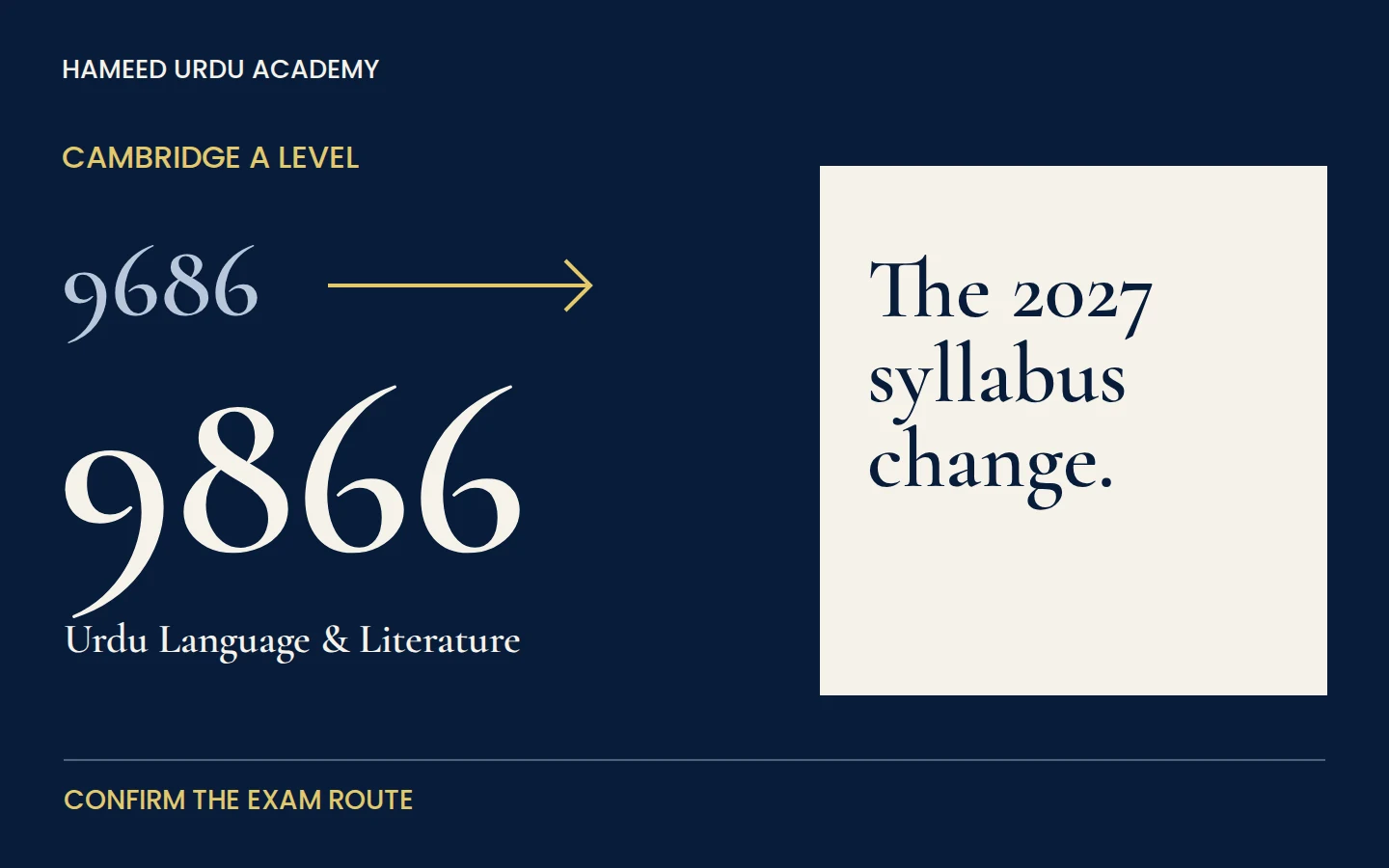
Cambridge International A Level Urdu 9686 is not the May/June 2027 route. Cambridge states that the new Urdu Language & Literature syllabus 9866 replaces 9686 from assessment in 2027. The last examination series for 9686 is November 2026, while 9866 is new for first examination in 2027.
For parents and students, this is more than a code change. The official syllabus says the assessment structure is different, so a preparation plan built only around 9686 papers can leave important 9866 demands uncovered.
What changed—and what did not
| Question | Verified answer |
|---|---|
| Which syllabus ends? | Cambridge International A Level Urdu 9686; last examination series November 2026. |
| Which syllabus begins? | Cambridge International A Level Urdu Language & Literature 9866; first examination in 2027. |
| Is this only a renamed paper? | No. Cambridge states that the assessment structure differs from 9686. |
| Where is 9866 listed? | Cambridge labels the qualification “for centres in Pakistan.” Students must confirm availability and entry details with their school or centre. |
| Can old resources still help? | Some language practice may remain useful, but old 9686 papers are not a complete blueprint for the new assessment. |
The 9866 assessment structure
All candidates take three externally assessed papers in the same examination series. Each paper is worth 40 marks and approximately one-third of the A Level.
Reading
1 hour 30 minutes · 40 marks
Multiple-choice, gap-fill and matching questions across a range of text types.
Writing
2 hours · 40 marks
One argumentative or discursive task and one descriptive or narrative task, each 300–400 words.
Literature
2 hours · 40 marks
Two responses: one passage-based question and one essay question on the prescribed literature.
The balance matters. A student needs reading comprehension, extended writing and literature preparation—not only general fluency or memorised essays.
What should a May/June 2027 student do now?
- Confirm the entry. Ask the school or examination centre to verify the awarding body, syllabus code and examination series.
- Use the 2027–2029 syllabus. Do not plan from an old 9686 course outline or an unverified social-media post.
- Check all three skill areas. Review reading, timed writing and literature separately.
- Confirm the 2027 set texts. Cambridge notes that set texts can rotate by examination year.
- Use specimen material deliberately. Learn the new task structure before relying on historical practice.
- Start with an actual answer. One recent response is more useful for diagnosis than a general statement such as “Urdu is weak.”
Readiness warning signs
- The student or tutor still calls the May/June 2027 course “9686.”
- The revision plan does not separate Reading, Writing and Literature.
- No one has checked the prescribed texts for the 2027 examination year.
- Writing practice is not timed or reviewed against task, organisation and accuracy.
- The student is using old papers without first learning the new assessment format.
Considering specialist 9866 tuition? Share the exam session, current learning needs and available lesson times. HUA will discuss programme suitability and fees before an assessment is arranged.
Check tuition suitabilityFrequently asked questions
Can a student enter 9686 in May/June 2027?
No. Cambridge identifies November 2026 as the last examination series for 9686 and states that 9866 replaces it for assessment from 2027.
Can 9686 past papers still be used?
They may support selected language practice, but they should not be treated as a full simulation of 9866. The new syllabus uses a different assessment structure and should guide preparation.
Does 9866 include literature?
Yes. Literature is a separate 2-hour, 40-mark paper and carries approximately one-third of the qualification.
Do the set texts stay the same every year?
Not necessarily. Cambridge says set texts regularly rotate and may change from one examination year to the next. Use the list for the student’s actual exam year.